• RSS
Показаны сообщения с ярлыком architecture. Показать все сообщения

четверг, 10 марта 2016 г.

Spasskaya Tower


Spasskaya Tower

From Wikipedia, the free encyclopedia
The Spasskaya Tower
Spaskaja Bašňa (спасская башня) The Saviour tower (6078983317).jpg
The Spasskaya Tower
General information
LocationMoscow, Russia
Height71 m
The Spasskaya Tower (Russian: Спасская башня, translated as "Saviour Tower") is the main tower with a through-passage on the eastern wall of the Moscow Kremlin, which overlooks the Red Square.

History[edit]

The Spasskaya Tower was built in 1491 by the Italian architect Pietro Antonio Solari. Initially, it was named the Frolovskaya Tower after the Church of Frol and Lavr in the Kremlin (no longer there). The tower's modern name comes from the icon of Spas Nerukotvorny (The Saviour Not Made by Hands), which was placed above the gates on the inside wall in 1658 (it was removed in 1917) and the wall-painted icon of Spas Smolensky(Smolensky Saviour), which was created in the 16th century on the outside wall of tower (plastered over in 1937, reopened and restored in 2010). The Spasskaya Tower was the first one to be crowned with the hipped roof in 1624–1625 by architects Bazhen Ogurtsov and Christopher Galloway (a Scottish architect and clockmaker). According to a number of historical accounts, the clock on the Spasskaya Tower appeared between 1491 and 1585. It is usually referred to as the Kremlin chimes (Кремлёвские куранты) and designates official Moscow Time.
The tower gate was once the main entrance into the Kremlin. In czarist times, anyone passing through the gates had to remove their headgear and dismount their horses. This tradition was broken in the soviet era. Cars approached the gate head on from the place of skulls and the road beside GUM. In order to pass through the gate, you had to be a head of state, top politburo member, or top government member. All other traffic was routed through the borovistky gate. The spassky gate posed an issue following the collapse of communism. In the new capitalist and market based economy, the passage of vehicles disrupted the flow of pedestrians to GUM and other shopping centers, even though few vehicles actually passed through the gate each day. In 1999, the decision was made to finally close the gate to all traffic. The signal lights and guard platforms still remain. The gate is used occasionally when repairs must be made to the borovissky gate. However, in that case, all traffic is routed from vasilievsky spusk. Nowadays, the gate opens to receive the presidential motorcades on inauguration day, for the victory parades, and to receive the new years tree.

понедельник, 11 января 2016 г.

Saint Basil's Cathedral


The Cathedral of Vasily the Blessed (Russian: Собор Василия Блаженного), commonly known as Saint Basil's Cathedral, is a church in Red Square in Moscow, Russia. The building, now a museum, is officially known as the Cathedral of the Intercession of the Most Holy Theotokos on the Moat (Russian: Собор Покрова пресвятой Богородицы, что на Рву) or Pokrovsky Cathedral (Russian: Покровский собор). It was built from 1555–61 on orders from Ivan the Terrible and commemorates the capture of Kazan and Astrakhan. A world famous landmark, it was the city's tallest building until the completion of the Ivan the Great Bell Tower in 1600.

воскресенье, 16 декабря 2012 г.

Ferapontov Monastery: Russian Medieval Treasure


The Ferapontov convent (Russian: Ферапонтов монастырь), in the Vologda region of Russia, is considered one of the purest examples of Russian medieval art, a reason given by UNESCO for its inscription on the World Heritage List.

Vologodskaya Oblast The Ferapontov Monastery. Russia

The monastery was founded by Saint Ferapont in 1398 in the inhospitable Russian North, to the east from the Kirillo-Belozersky Monastery, named after his fellow monk, Saint Kirill of Beloozero. The fame of the monastery started to spread under Kirill's disciple, Saint Martinian, who was to become a father superior of the Troitse-Sergiyeva Lavra in 1447.

Even after Martinian's death, his monastery was protected and favoured by members of Ivan III's family. The most ancient structure, the Cathedral of Nativity of the Virgin (1490), was built in brick by the masters of Rostov. This edifice is the best preserved of three sister cathedrals erected in the 1490s in the Russian North. All the interior walls are covered with invaluable frescoes by the great medieval painter Dionisius. This is the last surviving Russian medieval church with fully painted walls.

вторник, 6 сентября 2011 г.

Alpha Show 4D, Moscow State University

Alfa Show 4D, the largest video mapping projection attempted in history took place on September 4, 2011 at Vorob'yovy Gory (Sparrow Hills), Moscow. More than 800, 000 people attended the event.


Creator - David Atkins
Producer - Viktor Shkipin, Marketing Director, Alfa Bank

среда, 30 марта 2011 г.

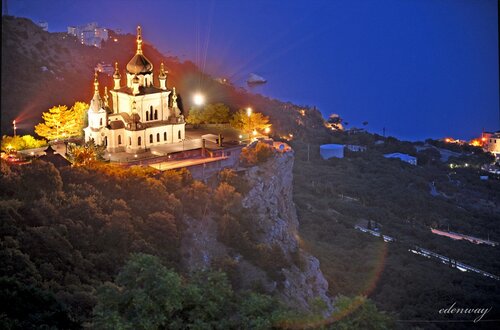
Foros Church


The Church of Christ's Resurrection is a popular tourist attraction on the outskirts of Yalta in the Crimea, known primarily for its scenic location, overlooking the Black Sea littoral from a 400-metre cliff near Baidarsky Pass.

Church of Christ's Resurrection. Photo by edenway, on yandex.fotki

The church overlooking the village of Foros was commissioned by a local landowner to commemorate Alexander III's survival in the Borki train disaster (1888). The landowner's name was Alexander Kuznetsov; he was a tea trader from Moscow. Nikolai Chagin, a celebrated architect from Wilno, designed the church in a bizarre blend of Rastrelliesque Baroque, Russian Revival, and Byzantine Revival.
The church was consecrated on 4 October, 1892 in the name of the Resurrection of Christ in a ceremony attended by Konstantin Pobedonostsev. The last Tsar, Nicholas II of Russia, and his wife prayed at the church on the day of the 10th anniversary of the Borki incident.
After the Russian Revolution the church was closed for worshippers, its priest exiled to Siberia and frescoes overpainted. The building was used as a snackbar for tourists until 1969 and stood empty throughout the 1970s and 1980s. It was returned to the Orthodox Church and went through four restoration campaigns.
Source: wiki

среда, 21 июля 2010 г.

Saint Petersburg From Above

The spire of the Saints Peter and Paul Cathedral / Шпиль Петропавловской крепости


Saints Peter and Paul Cathedral (general view) / Общий вид Петропавловской крепости


Related Posts with Thumbnails
Our website may contain affiliate marketing links, which means we may get paid commission on sales of those products or services we write about. Unless stated otherwise, our editorial content is not influenced by advertisers or affiliate partnerships. This disclosure is provided in accordance with the Federal Trade Commission's 16 CFR § 255.5: Guides Concerning the Use of Endorsements and Testimonials in Advertising.