The Cathedral of Vasily the Blessed (Russian: Собор Василия Блаженного), commonly known as Saint Basil's Cathedral, is a church in Red Square in Moscow, Russia. The building, now a museum, is officially known as the Cathedral of the Intercession of the Most Holy Theotokos on the Moat (Russian: Собор Покрова пресвятой Богородицы, что на Рву) or Pokrovsky Cathedral (Russian: Покровский собор). It was built from 1555–61 on orders from Ivan the Terrible and commemorates the capture of Kazan and Astrakhan. A world famous landmark, it was the city's tallest building until the completion of the Ivan the Great Bell Tower in 1600.
Показаны сообщения с ярлыком Orthodoxy. Показать все сообщения
Показаны сообщения с ярлыком Orthodoxy. Показать все сообщения
понедельник, 11 января 2016 г.
Saint Basil's Cathedral
The Cathedral of Vasily the Blessed (Russian: Собор Василия Блаженного), commonly known as Saint Basil's Cathedral, is a church in Red Square in Moscow, Russia. The building, now a museum, is officially known as the Cathedral of the Intercession of the Most Holy Theotokos on the Moat (Russian: Собор Покрова пресвятой Богородицы, что на Рву) or Pokrovsky Cathedral (Russian: Покровский собор). It was built from 1555–61 on orders from Ivan the Terrible and commemorates the capture of Kazan and Astrakhan. A world famous landmark, it was the city's tallest building until the completion of the Ivan the Great Bell Tower in 1600.

четверг, 7 января 2016 г.
CHRISTMAS MESSAGE OF PATRIARCH KIRILL OF MOSCOW AND ALL RUSSIA
Patriarchal message in English and Russian languages
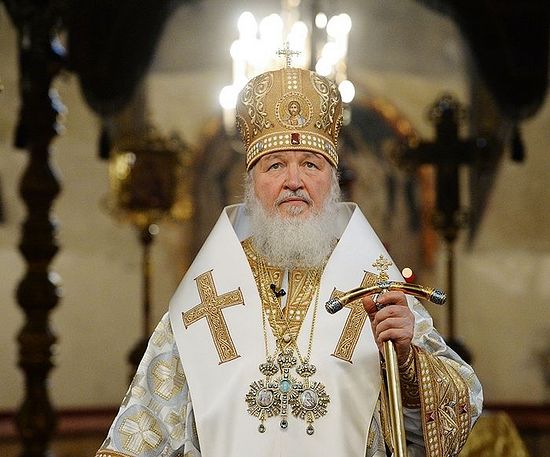
CHRISTMAS MESSAGE OF PATRIARCH KIRILL OF MOSCOW AND ALL RUSSIA
In this was manifested the love of God toward us, because that God sent his only begotten Son into the world, that we might live through him.
(1 Jn 4:9)
Your Eminences the archpastors, esteemed fathers,
all-honourable monks and nuns, dear brothers and sisters!
It is with a heart overflowing with joy in the Son of God who has come in the flesh that I address all of you and congratulate you on the radiant and life-bearing feast of the Nativity of our Lord and God and Saviour Jesus Christ.
“Glory to God in the highest, and on earth peace, good will toward men” (Lk 2:14). In glorifying from year to year the ineffable benevolence shown to us by the Saviour, we, as once the shepherds of Bethlehem who heard from the angel the “great joy, which shall be to all people” (Lk 2:10), hasten with spiritual eyes to see the Messiah, whose coming was foretold by the glorious prophets and awaited by a great multitude of men and women.
воскресенье, 7 апреля 2013 г.
Ustyug Annunciation
Annunciation of Ustyug (Russian: Устюжское Благовещение) is a Russian Annunciation icon, created in Novgorod in the 12th century, and one of the few icons which survived the Mongol invasion of Rus'. The Annunciation of Ustyug is currently held in the Tretyakov Gallery.
%C2%BB.+Novgorod+icon+fom+Tretyakov+Gallery+(Russia)..jpg "«Annunciation Ustyuzhskoe (from Ustyuzh)». Novgorod icon fom Tretyakov Gallery (Russia).") |
«Annunciation Ustyuzhskoe (from Ustyuzh)». Novgorod icon fom Tretyakov Gallery (Russia).
|
воскресенье, 16 декабря 2012 г.
Ferapontov Monastery: Russian Medieval Treasure
The Ferapontov convent (Russian: Ферапонтов монастырь), in the Vologda region of Russia, is considered one of the purest examples of Russian medieval art, a reason given by UNESCO for its inscription on the World Heritage List.

The monastery was founded by Saint Ferapont in 1398 in the inhospitable Russian North, to the east from the Kirillo-Belozersky Monastery, named after his fellow monk, Saint Kirill of Beloozero. The fame of the monastery started to spread under Kirill's disciple, Saint Martinian, who was to become a father superior of the Troitse-Sergiyeva Lavra in 1447.
Even after Martinian's death, his monastery was protected and favoured by members of Ivan III's family. The most ancient structure, the Cathedral of Nativity of the Virgin (1490), was built in brick by the masters of Rostov. This edifice is the best preserved of three sister cathedrals erected in the 1490s in the Russian North. All the interior walls are covered with invaluable frescoes by the great medieval painter Dionisius. This is the last surviving Russian medieval church with fully painted walls.
воскресенье, 5 февраля 2012 г.
VLADIMIR ICON OF THE MOTHER OF GOD
Article from http://www.pravoslavie.ru
The histories of Moscow and of the icon of Vladimir Mother of God are eternally inseparable. How many times did the Mother of God save the capital city from enemies through the grace of her holy icon? This icon has linked Apostolic times to Byzantium, Kievan Rus’ to Vladimir Rus’, and later to Muscovy, the Third Rome; as it is said, “there will be no Fourth.” The kingdom of Moscow was formed by divine providence and embraced the mystical ties of ancient empires, historical experience and traditions of other Orthodox peoples. The miracle working Vladimir icon became a symbol of unity and succession.
VLADIMIR ICON OF THE MOTHER OF GOD
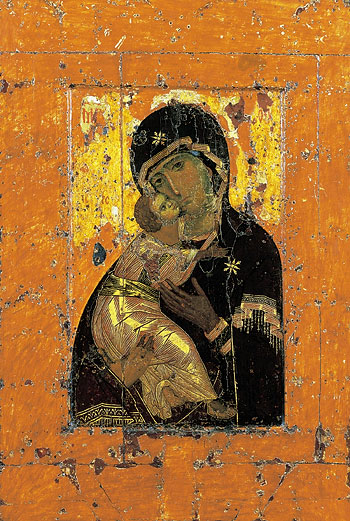 |
| Vladimir Icon of the Mother of God. Commemorated May 21/June 3; June 23/July 6; and August 26/September 8 |
Words cannot describe this icon; any verbal expression would be hollow compared to the gaze of the Theotokos from her image. This look contains everything – life and death; resurrection, eternity, immortality. According to ancient tradition, the Holy Evangelist, Physician, and Iconographer Luke painted three icons of the Theotokos. When the Most Pure One looked at them, she said: “May the grace of the One Who was born of me, and my grace, be with these Holy Icons.” One of these Icons is now known as the Vladimir icon. This depiction of Our Lady was kept in Jerusalem until 450 AD, after which it was taken to Constantinople. In the first half of twelfth century Luke Chrysoberges, Patriarch of Constantinople, sent the icon (together with the other image of Theotokos, known as “Pirogoschaya”) as a gift to Grand Duke Yuri Vladimirovich Dolgoruky, who placed it in the Vyshgorod convent (near Kiev), an area once belonging to Equal-to-the-Apostles, Grand Duchess Olga. In 1155 Vyshgorod became a possession of Prince Andrew, son of Yuri Dolgoruky.
воскресенье, 12 июня 2011 г.
Trinity (Pentecost) Sunday in Russia
Trinity Sunday (also called Trinity Day, or Descent of the Holy Spirit) is the Sunday of Pentecost, one of the Great Feasts of the Orthodox Church, celebrated fifty days after Pascha (thus always falling on a Sunday).
In Russia the feast is known as Troitsa (Троица - the Trinity). The liturgical color used at Pentecost is green, and the clergy and faithful carry flowers and green branches in their hands during the services.
Read more on orthodoxwiki
In Russia the feast is known as Troitsa (Троица - the Trinity). The liturgical color used at Pentecost is green, and the clergy and faithful carry flowers and green branches in their hands during the services.
Read more on orthodoxwiki
 |
| К ТРОИЦЕ. СЕРГЕЙ КОРОВИН (1902) via fotki.yandex |
понедельник, 25 апреля 2011 г.


среда, 30 марта 2011 г.
Foros Church
The Church of Christ's Resurrection is a popular tourist attraction on the outskirts of Yalta in the Crimea, known primarily for its scenic location, overlooking the Black Sea littoral from a 400-metre cliff near Baidarsky Pass.
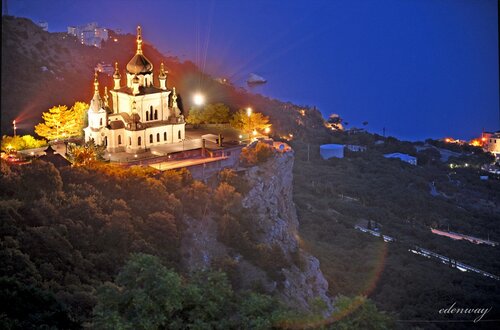 |
| Church of Christ's Resurrection. Photo by edenway, on yandex.fotki |
The church overlooking the village of Foros was commissioned by a local landowner to commemorate Alexander III's survival in the Borki train disaster (1888). The landowner's name was Alexander Kuznetsov; he was a tea trader from Moscow. Nikolai Chagin, a celebrated architect from Wilno, designed the church in a bizarre blend of Rastrelliesque Baroque, Russian Revival, and Byzantine Revival.
The church was consecrated on 4 October, 1892 in the name of the Resurrection of Christ in a ceremony attended by Konstantin Pobedonostsev. The last Tsar, Nicholas II of Russia, and his wife prayed at the church on the day of the 10th anniversary of the Borki incident.
After the Russian Revolution the church was closed for worshippers, its priest exiled to Siberia and frescoes overpainted. The building was used as a snackbar for tourists until 1969 and stood empty throughout the 1970s and 1980s. It was returned to the Orthodox Church and went through four restoration campaigns.
Source: wiki
среда, 16 февраля 2011 г.
Nunc Dimittis
The Nunc dimittis (also Song of Simeon or Canticle of Simeon, Russian: «Ныне отпущаеши…», Песнь Симеона Богоприимца) is a canticle from a text in the second chapter of Luke (Luke 2:29–32) named after its first words in Latin.
The famous ‟O Lord now lettest Thou thy servant depart in peace‟ (in Russian‟ Nyne otpuschayeshi‟) has been opportunity for many composers to create beautiful music.
Nunc dimittis («Ныне отпущаеши…») sung by Feodor Shalyapin in 1932 and 1911.
Текст
- English (Book of Common Prayer, 1662):
- Lord, now lettest thou thy servant depart in peace : according to thy word.
- For mine eyes have seen : thy salvation,
- Which thou hast prepared : before the face of all people;
- To be a light to lighten the Gentiles : and to be the glory of thy people Israel.
- Церковнославянский
- Ныне отпущаеши раба Твоего, Владыко, по глаголу Твоему, с миром;
- яко видеста очи мои спасение Твое,
- еже еси уготовал пред лицем всех людей,
- свет во откровение языком, и славу людей Твоих Израиля.
- Русский
- Ныне отпускаешь раба Твоего, Владыко, по слову Твоему, с миром,
- ибо видели очи мои спасение Твое,
- которое Ты уготовал пред лицем всех народов,
- свет к просвещению язычников и славу народа Твоего Израиля.
вторник, 15 февраля 2011 г.
Праздник Сретения
THE MEETING OF THE LORD
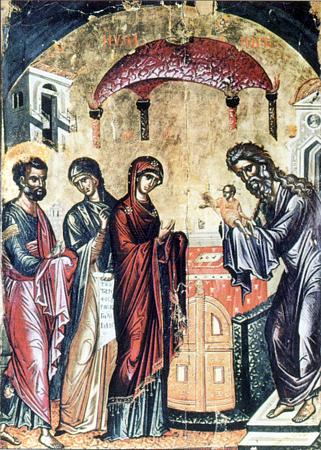 |
| The Meeting of the Lord. |
According to the Law of Moses, all Hebrew parents must bring their first born son on the fortieth day after birth to the Temple to be consecrated to God. It was the custom to bring a sacrifice in thanksgiving to God. The law was established in remembrance of the exodus of the Hebrews from Egypt — freedom from slavery — when the first-born Hebrews were spared from death.
In fulfilment of this law, the Mother of God with Joseph brought the infant Jesus to the Temple in Jerusalem and brought for the sacrifice two fledgling doves.
At this time in Jerusalem, there lived an old man by the name of Simeon. He was a righteous, pious man, and he awaited the coming of the Messiah. It was foretold to him by the Holy Spirit that he would not have died before he had seen Christ the Lord. Simeon waited for the fulfilment of the promise of God for a long time. According to tradition, he lived about 300 years. Then, one day, by the inspiration of the Holy Spirit, he went to the Temple. When Mary with Joseph brought the infant Jesus, Simeon met the Child, took Him in his arms, and glorifying God said, "Now lettest Thou Thy servant depart in peace, O Master, according to Thy word, for mine eyes have seen Thy salvation, which Thou hast prepared before the face of all peoples, a light of revelation for the Gentiles, and the glory of Thy people Israel."
вторник, 21 сентября 2010 г.
The Nativity of the Theotokos
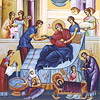 Рождество Пресвятой Богородицы 8/21 сентября
The Nativity of the Theotokos, celebrating the birth of Mary, is one of the Twelve Great Feasts of the Eastern Orthodox liturgical year. It is celebrated on September 8 on the liturgical calendar (for those churches which follow the traditional Julian Calendar, including Russian Orthodox Church, September 8 falls on September 21 of the modern Gregorian Calendar).

The Nativity of Our Most Holy Lady Theotokos and Ever Virgin Mary: The Most Holy Virgin Mary was born at a time when people had reached such a degree of moral decay that it seemed altogether impossible to restore them. People often said that God must come into the world to restore faith and not permit the ruin of mankind.
The Son of God chose to take on human nature for the salvation of mankind, and chose as His Mother the All-Pure Virgin Mary, who alone was worthy to give birth to the Source of purity and holiness.
The Nativity of Our Most Holy Lady Theotokos and Ever Virgin Mary is celebrated by the Church as a day of universal joy. Within the context of the Old and the New Testaments, the Most Blessed Virgin Mary was born on this radiant day, having been chosen before the ages by Divine Providence to bring about the Mystery of the Incarnation of the Word of God. She is revealed as the Mother of the Savior of the World, Our Lord Jesus Christ.
The Most Holy Virgin Mary was born in the small city of Galilee, Nazareth. Her parents were Righteous Joachim of the tribe of the Prophet-King David, and Anna from the tribe of the First Priest Aaron. The couple was without child, since St Anna was barren.
Having reached old age, Joachim and Anna did not lose hope in God's mercy. They had strong faith that for God everything is possible, and that He would be able to overcome the barrenness of Anna even in her old age, as He had once overcame the barrenness of Sarah, spouse of the Patriarch Abraham. Sts Joachim and Anna vowed to dedicate the child which the Lord might give them, to the service of God in the Temple.
Childlessness was considered among the Hebrew nation as a Divine punishment for sin, and therefore the righteous Sts Joachim and Anna had to endure abuse from their own countrymen. On one of the feastdays at the Temple in Jerusalem the elderly Joachim brought his sacrifice to offer to God, but the High Priest would not accept it, considering him to be unworthy since he was childless.
St Joachim in deep grief went into the wilderness, and there he prayed with tears to the Lord for a child. St Anna wept bitterly when she learned what had happened at the Jerusalem Temple. Never once did she complain against the Lord, but rather she prayed to ask God's mercy on her family.
The Lord fulfilled her petitions when the pious couple had attained to extreme old age and prepared themselves by virtuous life for a sublime calling: to be the parents of the Most Holy Virgin Mary, the future Mother of the Lord Jesus Christ.
The Archangel Gabriel brought Joachim and Anna the joyous message that their prayers were heard by God, and of them would be born a most blessed daughter Mary, through Whom would come the Salvation of all the World.
The Most Holy Virgin Mary surpassed in purity and virtue not only all mankind, but also the angels. She was manifest as the living Temple of God, so the Church sings in its festal hymns: "the East Gate... bringing Christ into the world for the salvation of our souls" (2nd Stikhera on "Lord, I Have Cried", Tone 6).
The Nativity of the Theotokos marks the change of the times when the great and comforting promises of God for the salvation of the human race from slavery to the devil are about to be fulfilled. This event has brought to earth the grace of the Kingdom of God, a Kingdom of Truth, piety, virtue and everlasting life. The Theotokos is revealed to all of us by grace as a merciful Intercessor and Mother, to Whom we have recourse with filial devotion.
Source: Orthodox Church in America